Despite government plans to increase homebuilding across the capital, the lack of new properties means most Londoners are still looking towards extensions and renovations to improve their homes. Here are five trends for 2025 that reflect a growing preference for more sustainable, connected, and adaptable home renovations.
‘Broken plan’ design
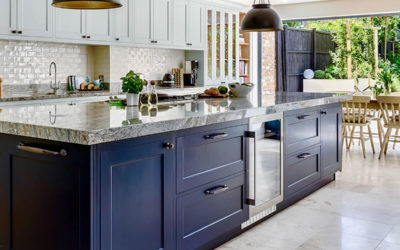
Open plan designs are still popular, but with many of us still working from home as much as in the office, the idea of a ‘broken plan’ space brings more nuance to the idea. With a broken plan you can still have the large airy spaces of an open plan layout, but within that, you should be able to subdivide the space when required.
For example, instead of just a single wide-open space that connects the sitting room, dining room, and kitchen, the idea is that between each room, you have some sort of divider, such as internal Crittall-style and aluminium doors, which can divide the space. Sometimes, you may want to entertain guests with the whole area open, but at others, someone may need to be working in one room while other family members are eating supper or watching television.
In a carefully designed broken plan layout, each “room” will be designed to work perfectly individually when sectioned off from the rest as well as part of the grander whole with all the doors and dividers open. This offers flexibility and the best of both worlds in terms of space and privacy.
Eco-friendly bathrooms
The trend for bathrooms to be sanctuaries continues to be popular. However, alongside that, this year, we are seeing a renewed focus on sustainability, and there is no reason a well-designed bathroom cannot be both!
Homeowners are increasingly choosing more sustainable and eco-friendly fixtures such as low-flow toilets and water-saving shower heads. Combine these elements with LED lighting and energy-saving radiators or underfloor heating and you will be well placed to both reduce your environmental impact and save money on utility bills.
Smart-home integrations
The smart home has finally become ubiquitous in London properties. These technologies have been on the horizon for decades, but now they are simpler to use and lower cost than ever, with a quarter of UK homes now considered to be “smart” in some way.
If you are renovating your London property, including smart elements has almost become a baseline requirement, with people increasingly choosing to include app-controlled lighting, wireless speakers, digital security systems, smart heating systems, and connected dishwashers and washing machines. Luckily, these technologies are no longer the complex beasts that they once were to install, and even London’s wealthiest residents are choosing off-the-shelf solutions that “just work” and connect effortlessly to Apple Homekit (iPhone) or Google Home (Android).
The benefits of integrating smart home technology are extensive. These technologies do not only make our lives easier but can also help us save on our energy bills. It is now simple to set up routines where the lights are automatically switched off when nobody is at home, or each room is heated individually instead of heating the whole house when everybody is together in the sitting room, or to use the tumble dryer only overnight when energy is cheapest.
Outdoor living spaces and multi-functional garden rooms
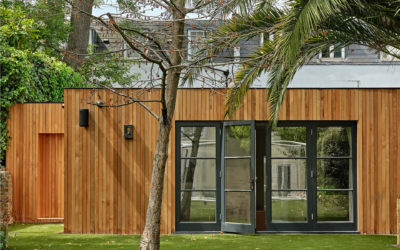
Space remains at a premium in London, and for many homeowners one of the most cost-effective ways to add additional space to their home is with the addition of a garden room. These spaces are most commonly used as home offices away from the hubbub of the family home, but they are multifunctional by design and could just as easily work as a home gym or hobby room.
Today’s garden rooms are nothing like the sheds of yesteryear. They are generally well-insulated against the elements, heated, and offer electrical and digital connectivity. Add in some large bifold doors and the space offers a seamless connection to the garden and a space that may be used as an office during the week, but on weekends is a more social space when the family is outside. They can transform a property, and critically, they can increase a property’s functional space without encroaching on existing structures and can therefore add significant value to any London home.
Self-care spaces
London life is hectic, and with a family, it can be difficult to find the time and space to relax and unwind. As a result, it is unsurprising that homeowners in the capital are increasingly keen on the idea of creating a space just for themselves away from work and children. For some people this will be a luxurious sanctuary spa of a second bathroom, while for others, it may be a home gym or hobby room – whatever it is that they do to unwind and destress.
Finding the space for these rooms can be difficult, but the uptick in interest for garden rooms as well as the move away from having a “spare room” to one with a purpose (that may still include a futon or sofa-bed for when people do come and stay) is a sign that people are finding ways to create their own spaces within their home.
Are you looking to renovate your London property in 2025?
Good London Builders makes the process easy for you, from finding the right architect and contractors to making sure the whole project is completed on time and within budget. Call us today on 0207 978 5097 or contact us online.