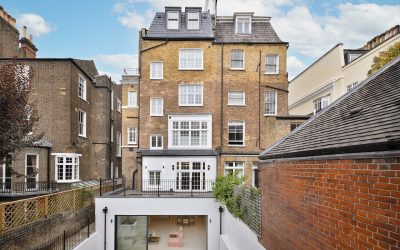
Compared to similar global cities, London’s properties offer smaller square-footage for eye-watering prices. London real estate comes at a premium, and that means that people are always looking to expand their properties by building up into their attics, out into their gardens, or down into their basements—the focus of this guide.
What is the difference between a cellar conversion, basement conversion, and basement extension?
People often use these three phrases interchangeably, but there are some key differences between each development of a basement.
Basement conversion
A basement conversion is the renovation of an existing basement into a functional living area, which generally includes 1-3 rooms.
Cellar conversion
A cellar conversion involves renovating a cellar, which is typically a smaller space than a basement, into a functional living area.
Basement extension
A basement extension is the development of a new basement level beneath an existing property. This could involve expanding the size of the original basement or digging out an entirely new basement beneath the existing property.
Why are basement conversions so popular in London?
Space is at a premium in London, and for those that are looking to find more room in their current property a basement conversion has become a popular choice in recent years.
Basement conversions can add significant extra floorspace to a property, making room for extra bedrooms, home offices, gyms, cinemas and more. The additional square footage created by a high quality basement conversion can also add up to 25 per cent to the value of a property.
Basements tend to be quiet spaces, away from the bustle of a home, so many homeowners choose to build a home office in the new underground rooms. Others use that extra space for separate but attached dwellings, such as creating a ‘granny annexe’, while some simply use the additional space for extra storage for their growing family.
According to a recent study published in the journal Urban Geography, over the last decade basement extensions have become as common as loft conversions in London, with nearly 1,000 approved by planners each year.
The vast majority (80%) of basement conversions are single-storey conversions that could be used for an extra bedroom or two. Around two per cent are the so-called “mega basements” that extend under the garden and span multiple storeys. Hammersmith and Fulham had the highest number of standard basement conversions, with the mega basement extensions mostly constructed in the Royal Borough of Kensington and Chelsea.
What are the alternatives to a basement conversion?
Loft conversion
Loft conversions have traditionally been the most popular way for Londoners to expand their property’s square footage. Loft conversions tend to be cost-effective as if the attic space has sufficient headroom for the conversion then the project is relatively quick compared to constructing an extension or excavating a basement. However, today many London properties have already converted their attic space for the extra bedrooms and so for those looking to expand further this is no longer an option.
Extension
Extensions come in many many different shapes and sizes. Small side-returns can make use of otherwise under-utilised garden space, while rear extensions can be much larger and a wrap-around extension combines the two. And then the extensions can be one or two storeys depending on budget and requirements.
Compared to converting existing attics or basements, extensions involve the construction of entirely new structures, which mean foundations, brickwork, and more. The time it takes to build extensions often makes them more expensive than a conversion project, but they do afford home-owners more flexibility as they are not limited by the existing structure.
Garden room
Garden rooms have become increasingly popular in recent years with people increasingly working from home for a portion of their week. They tend to come as flat-packs and are significantly cheaper to construct than extensions, but are also normally relatively small, offering just one or two small rooms. Garden rooms are counted in the square-footage of a property by estate agents and so can boost house prices, but the rooms tend to be built from wood and have less insulation than a traditional property and so be colder in the winter months.
Move house
The reason people look at converting this basement or attic, or building an extension is to avoid the time, stress, and expense of moving house. The stamp duty alone on purchasing a million pound London property is £43,750, and when you add to that the legal fees, mortgage fees, and the cost of movers then you could easily end up spending over £75,000 before you get to the cost of the new property. And then there are the stresses around finding new schools or routes to work. If you have the budget to upsize then moving may be a good option, but in general there is a reason many people choose to improve and not move!
How can Good London Builders help?
Good London Builders offers a ‘concierge-style’ project management service where we work closely with clients from helping them choose the best way to expand their home through the tender process and builder appointments to logistics and the final sign off at completion.
If you are considering a basement conversion or any expansion to your London property, call Good London Builders today on 0207 978 5097 or get in touch online.